
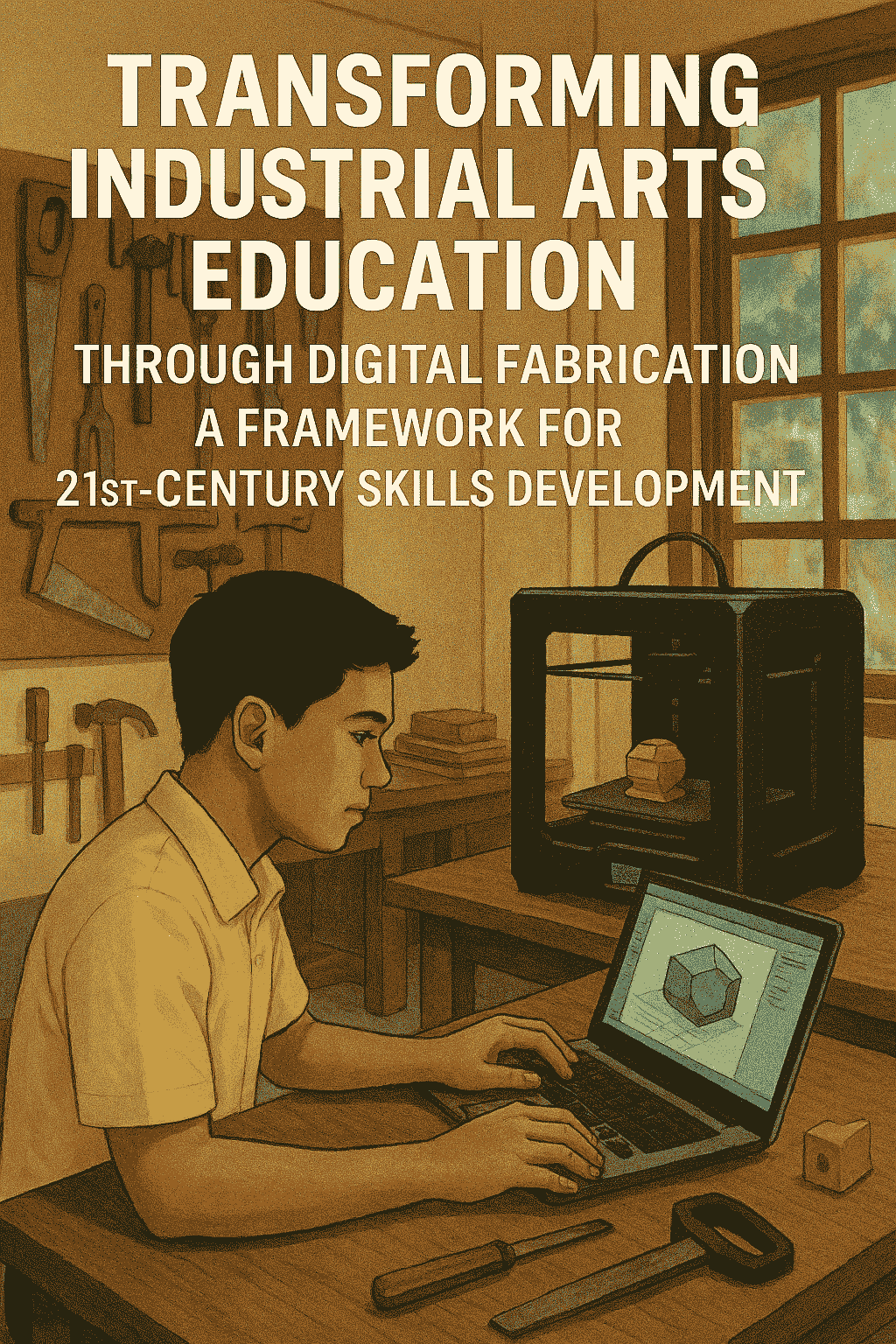
Transforming Industrial Arts Education Through Digital Fabrication
A Framework for 21st-Century Skills Development
DOI:
https://doi.org/10.64591/77jrrm69Keywords:
digital fabrication, Industrial Arts education, 21st-century skillsAbstract
This paper examines how digital fabrication is revolutionizing Industrial Arts education by integrating 21st-century skills into hands-on learning. Through tools such as 3D printing, CNC machining, and laser cutting, students engage in creative problem-solving and interdisciplinary design, fostering innovation and technological fluency. Grounded in constructivist and STEAM-based pedagogies, digital fabrication empowers learners to think critically and collaboratively while bridging traditional craftsmanship with modern digital literacy. The framework underscores the vital role of educators in facilitating this transformation and ensuring equitable access to emerging technologies.
References
Blikstein, P. (2013). Digital fabrication and ‘making’ in education: The democratization of invention. FabLabs: Of Machines, Makers and Inventors, 4(1), 1–21.
Buehler, E., Kane, S. K., & Hurst, A. (2014, October). ABC and 3D: Opportunities and obstacles to 3D printing in special education environments. In Proceedings of the 16th International ACM SIGACCESS Conference on Computers & Accessibility (pp. 107–114).
Clapp, E. P., Ross, J., Ryan, J. O., & Tishman, S. (2016). Maker-centered learning: Empowering young people to shape their worlds. John Wiley & Sons.
Koehler, M., & Mishra, P. (2009). What is technological pedagogical content knowledge (TPACK)? Contemporary Issues in Technology and Teacher Education, 9(1), 60–70.
Trilling, B., & Fadel, C. (2009). 21st century skills: Learning for life in our times. John Wiley & Sons.
Downloads
Published
Issue
Section
License
Copyright (c) 2025 TECH TAUGHT

This work is licensed under a Creative Commons Attribution 4.0 International License.


