
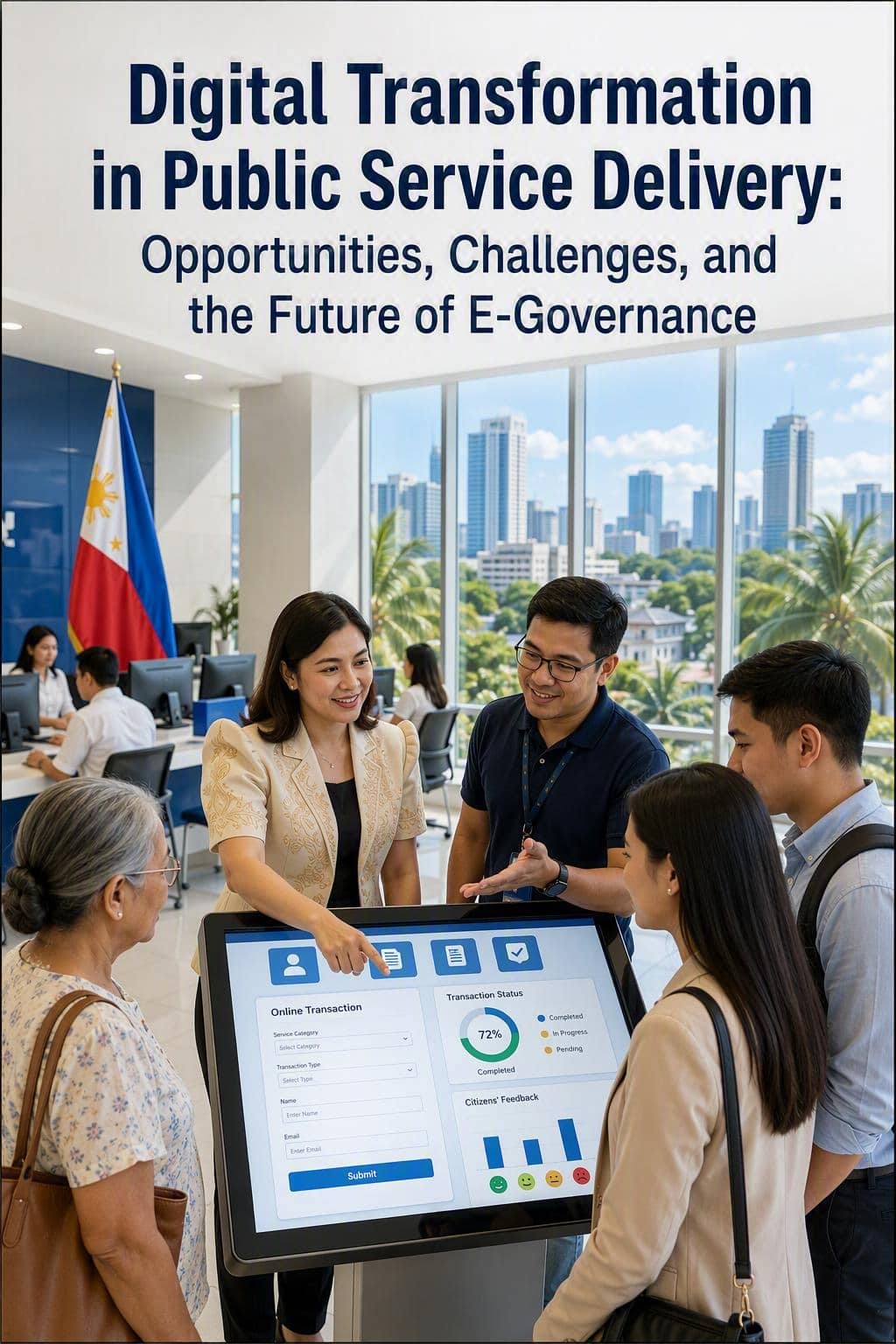
Digital Transformation in Public Service Delivery
Opportunities, Challenges, and the Future of E-Governance
DOI:
https://doi.org/10.64591/2htwye55Keywords:
Digital Transformation, E-Governance, Public Service DeliveryAbstract
igital transformation is reshaping public service delivery by enhancing efficiency, transparency, accessibility, and citizen engagement through e-governance technologies. While innovations such as artificial intelligence, cloud computing, and integrated digital platforms improve public administration, challenges related to cybersecurity, digital inclusion, and organizational readiness remain significant. Strengthening digital governance through inclusive policies and institutional reforms is essential for delivering secure, responsive, and citizen-centered public services.
References
Gil-Garcia, J. R., Dawes, S. S., & Pardo, T. A. (2018). Digital government and public management research: Finding the crossroads. Public Management Review, 20(5), 633–646. https://doi.org/10.1080/14719037.2017.1327181
Mergel, I., Edelmann, N., & Haug, N. (2019). Defining digital transformation: Results from expert interviews. Government Information Quarterly, 36(4), 101385. https://doi.org/10.1016/j.giq.2019.06.002
United Nations. (2024). United Nations E-Government Survey 2024: Accelerating digital transformation for sustainable development. United Nations.
Wirtz, B. W., & Müller, W. M. (2019). An integrated artificial intelligence framework for public management. Public Management Review, 21(7), 1076–1100. https://doi.org/10.1080/14719037.2018.1549268
Yang, Z., & Kankanhalli, A. (2021). Digital government transformation: A systematic literature review. Government Information Quarterly, 38(3), 101602. https://doi.org/10.1016/j.giq.2021.101602
Downloads
Published
Issue
Section
License
Copyright (c) 2026 TECH TAUGHT

This work is licensed under a Creative Commons Attribution 4.0 International License.


